
The Discipline of Do Easy
Burroughs, Magick, and the Art of Effortless Order

This weekend I cleared my pantry and cabinets of clutter and imposed a strict order on them, which cut the space I was using in half. These modest territories of our homes—closets, junk drawers, bookshelves long surrendered to disarray—speak directly to the manner in which we live. When our attention lapses, our spaces reflect the negligence.
My weekend exercise arose from necessity: it’s 110 outside so this is the season of indoor tasks, also my partner is moving in with me this week which adds another body to a small house already holding one man, two dogs, and an excess of books and records. To make this living situation work, every object will need a proper place and my disorderly habits will need reform. Times like these are when I revisit the Discipline of Do Easy (DE).
At the turn of the millennium, one of my daily stops on the internet was the website Disinfo.com. Disinformation was an online publisher who also published a few print books. Its most influential anthology was Book of Lies, a GenX anthology of occultism and chaos magick that collected writing from luminaries including Grant Morrison, Genesis P-Orridge, Erik Davis, Robert Anton Wilson, and others. That red volume with the playful devil on the cover is still one of my most treasured volumes.
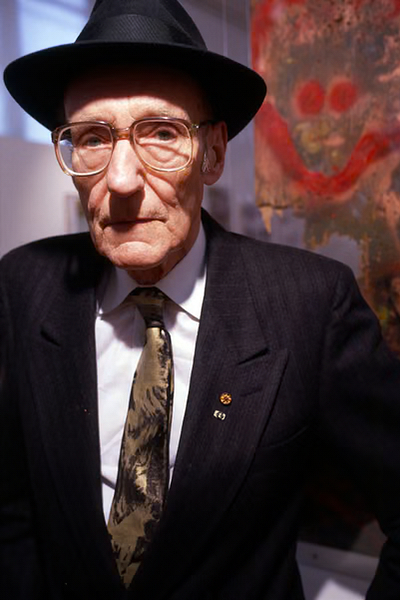
Buried in that book is William Burroughs’ essay “The Discipline of DE,” pulled from his 1973 collection Exterminator! Burroughs seems an unlikely source for self-help or magickal guidance given that his young life was as messy as it was, but for an innately disorganized man like myself, it struck a chord.
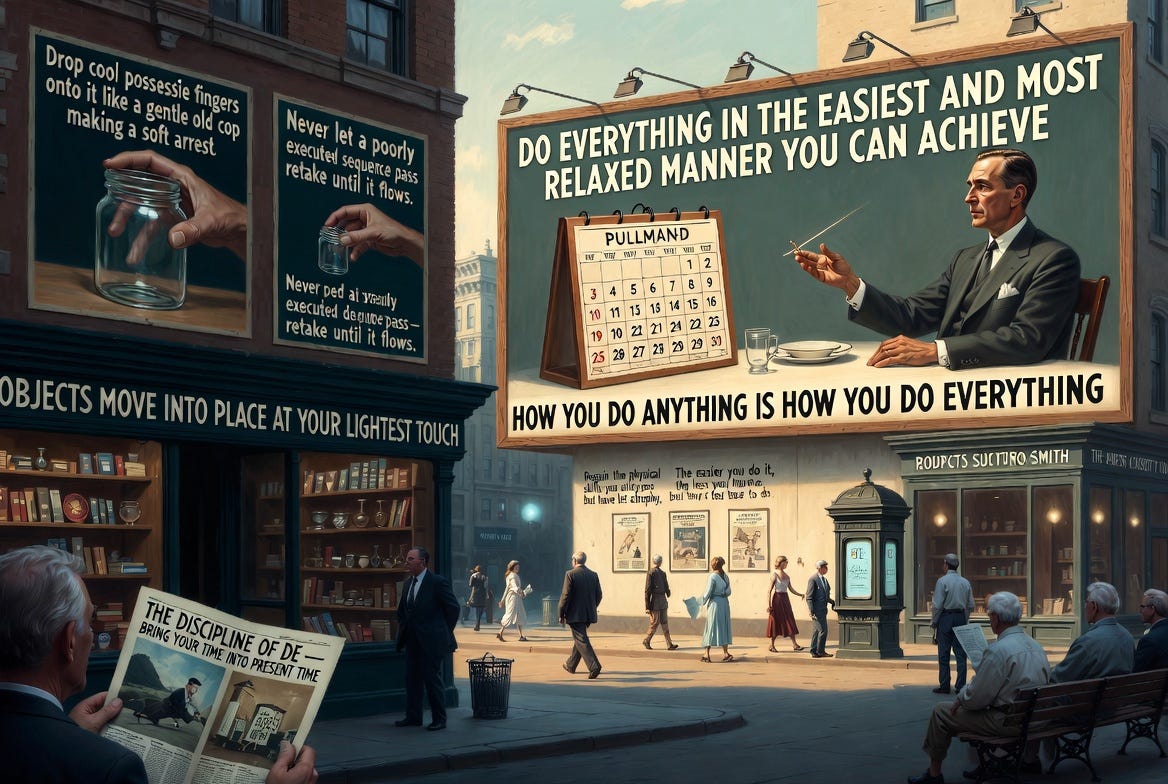
The essay introduces us to Colonel Sutton Smith, the kind of man who discusses Roman coins over exactly two sherries and never three. He is organized, methodical, and contemptuous of waste. He keeps the memoir he is writing on a strict calendar. The system frees him to step into the flow of memory and to coalesce the flotsam of a life well lived. He is drawn out of the present by this system and into the tide of memory, but when the writing is over, he returns to the present moment with rapt attention to detail.
In modern parlance we might say that the Col. lives with “mindfulness,” though that word is so degraded by overuse that it takes all I have not to throat punch anyone who uses it in my presence. In Burroughs’ world it is not mindfulness that the Col. adheres to; it is the Discipline of Do Easy or “DE.”
The concept of DE itself is simple to state and can be summarized as: do everything you do in the easiest and most relaxed manner you can achieve. When you stub your toe, hit a stray piece of furniture, toss a paper into a trash can but miss, the solution is to simply stop, rewind, and break the motion into still frames. Study those frames until the error is understood, then rewind and do it over. In accordance with the Discipline of DE, every action follows this simple process. All of the wasted energy and action will show, and once you find the easy way, your actions will run themselves. The easier you do it, the less you have to do.
A few years ago I taught a life-management class at a community college in central Oregon. I used “The Discipline of DE” in the middle of the term as a way to talk about living mindfully without the new age jargon that has attached to it like lichen. I taught it also because I felt it could be genuinely transformative for those students with an ADHD diagnosis, a prescription, and a stack of academic accommodations—which is an alarming percentage of the student body.
I would never deny a student with a genuine learning difference the tools they need to be successful, but ask anyone who has been in the teaching game long enough and they’ll tell you that more often than not those “accommodations” just excuses laziness and disorganization from young people who’ve never been forced to get themselves together. Rather than learn new habits (or more precisely to unlearn bad ones, they expect the world to accommodate them.
On the day that we discussed “The Discipline of DE,” I brought in a box of junk from my desk—paper clips, string, crumpled papers, an old shirt—and asked for two volunteers. I made sure to choose one student who was orderly and another who wasn’t. I sent one outside, set a timer, gave the box of junk a rigorous shake, then dumped it on the desk. I then asked the student to organize the pile. When the timer went off, we observed the student’s progress and reset the pile before asking the second student to come in and repeat the exercise.
The organized student would study the pile for a moment, then clear the big items that could be easily sorted first, then sort the small ones after. There was alway a system they used to organize the chaos. The other student would spend the entire time lining up paper clips with no discernible system in place. When time ran out the difference in their progress was obvious to everyone watching.
Ladies and gentlemen, that is the Discipline of DE in action. Every action we take can be done with or without attention, and the cumulative effect of how we live shapes our physical spaces, our relationships, our health, and the quality of the life we live. Arranging your junk drawer so that its contents have balance and harmony might seem trivial, but when you recognize that your life force either flows through these spaces or gets trapped within them, then these mundane tasks become the battlegrounds of our lives.
As Burroughs writes, How you do anything is how you do everything.
Burroughs goes further: “Once you break movement into frames and remove the waste, you begin to regain physical skills you already possess but have let atrophy. You know where the wastebasket is. You can land an object in it over your shoulder without looking. You know how to touch and move and pick up things. Regaining these physical skills is only the prelude. DE will show you how to use the computer in your brain.”
DE is one highly accessible method to train you in the art of Magick with a K—the spelling Crowley used to separate a long and sacred tradition from stage tricks and parlor games.
Crowley defined Magick as: the Science and Art of causing Change to occur in conformity with Will.
Gordon White has described it as a technique for increasing the probability that events will move in the direction you intend.
In the essay, Burroughs imagines Wyatt Earp, the Old West’s most efficient gunslinger, saying to a young man: “It’s not the first shot that counts, it is the first shot that hits.”
To understand DE is easy. To live inside it when the culture sells tension as virtue and distraction as connection takes constant diligence.
Mastering the Discipline of DE will change your life—you will eat only when hungry, exert only the right amount of energy in social and romantic situations, not force anything that doesn’t yield a result, you’ll put all of your energy only where it yields the best fruit.
Tasks finish faster, the mind is calmer, there’s more room for contemplation and creativity, but most important, you win back your time. If magick has any practical use, reclaiming the precious hours of your life is its most potent outcome.
I would like to say I am a constant and studied master of DE, but the truth is I often fail and when I do my living space and my productivity reflect this. That is why I reread the essay often and try to implement its simple yet transformative wisdom.
The Discipline of DE takes a lifetime to master, and you must return to it often to stay grounded in it.
For me, right now, the pantry is clear. The house has room for the man who is driving toward it. We will build the life we’re going to live together intentionally, or at least we’ll do so until the entropy sets in, I freak out, and retrace my steps—figuring out what’s going wrong, observing the action, and making change.
When you learn to do easy, nothing is a chore—all is practice, and the world bends in conformity to your will, and that is the highest form of Magick there is.
∞ 🇺🇸 🛻