
Storming the Gates
Part 1: Wrestling with Complexity

The border has become a monument to our failures. A failure to secure our citizens’ safety. A failure to protect our great nation’s sovereignty…A failure to our assurance that our republic endures for future American generations.
—J.J. Carrell, retired Border Patrol Agent of 24 years
Note: This is a multipart series
1. Wrestling with Complexity
I am sitting at my desk during office hours at the community college where I teach, wondering if any of my students will come by when our administrative assistant pops around the corner to tell me that a student is here to see me. I am surprised to see behind her a former student whom we’ll call him Jose. I thank our admin and invite Jose to have a seat.
Jose had not been my student for a couple of semesters, and he is not the type of student to casually drop by for a social visit, so I assume he is here for a letter of recommendation—the most common reason for such unexpected visits. Jose is a veteran who served multiple tours in Afghanistan. He was the type of student that was deferential but skeptical of your authority until you earned his respect (a quality I recognize in myself). Having just one student like Jose in a classroom completely alters the nature of the class for the better. Jose had been shot at, seen kids blown up, had his brothers in arms killed in front of him, and yet he bore it all with a quiet gravitas that the entitled 18-year-olds in the classroom simply couldn’t compete with. When he spoke, which was not often, they listened. To say that I admired him is an understatement. He was an excellent student who wrote complex, if imperfect, responses to our readings. That he thought deeply about my curriculum was evident, and that he respected me and the discussions I tried to have was the type of affirmation that made the job worth doing.
After some brief catching up, Jose got to the point of his visit. He stated explicitly, “I need help and I didn’t know who else to come to.” Then he told me his story. Jose is an American citizen through birthright citizenship; his parents, however, are not citizens. They came to this country illegally from Mexico before he was born. His father eventually found work as a landscaper and over the years earned enough money to raise his family in the comfortable middle-class suburbs east of Portland. Eventually Jose’s father would start his own landscaping business that employed a handful of people, including Jose.
A few months prior, Jose’s father had been returning from a job in Beaverton in his work truck when he failed to signal a turn and was pulled over by a cop driving behind him. This simple traffic error led to a cascade of events that would alter the life of Jose’s father, and his family, forever.
During the stop the cop discovered that Jose’s father did not have a license, nor any of the legal paperwork required to be in the country. He was arrested and eventually turned over to federal agents. Deported to Mexico, his father appealed and had a court date set but a family emergency led him to make a dumb mistake. Jose’s father paid a mule to smuggle him back over the border in Texas, but he was apprehended by federal agents and was now being held in federal custody. He was also permanently barred from re-entering the United States.
Jose had dropped out of college to take over the family business and try to keep it, and his family, afloat. He came to see me because I was the person in his life who might know how to help.
One of the things that happens as a community college instructor is that when your students come to trust you they can also believe that you have more power and authority than you do. I was heartbroken by Jose’s story but didn’t know what I could do to help. We talked over some possible options, I took down some notes along with his email address, spent the next several days gathering the resources that I could find, and sent him an email by the week’s end. I had hoped that the VA office could help since Jose was a veteran who had honorably served his country during wartime, but they, like all of the other resources I found, offered little in the way of support. Jose and I had a few email exchanges over the next few months and then the line went quiet. I never heard from Jose again and do not know what became of him and his father. I remember him sometimes and am still haunted by it.
Several years later I had left Portland and was living in Central Oregon. During my time there I befriended a man who was my opposite in many ways–he was a father, had a manual labor job, drove a giant truck, loved guns, and was a proud Trump-supporting Republican. The friendship was unlikely but in my time in Bend it was one of the most meaningful connections I made. When Dave (not his real name) would come to visit, politics always came up. What I valued about him was that he was an Oregon conservative, which broadly means that he was socially liberal but conservative on matters of fiscal policies, defense, and law enforcement. He, mostly, just wanted to live in a safe country and to be left the fuck alone, which I respected. We would debate vociferously about politics without ever reaching consensus but it didn’t matter. Dave and I had the type of friendship where each of us would say our piece, allow the other to say his piece, and then move on–as it should be. Because of this, I learned more from him than from any of the debates I’ve ever had online.
One day the issue of illegal immigration came up and I told Dave the story of Jose and his father thinking that the details of the story might soften Dave’s position. Jose was a veteran, deeply patriotic, his father was hard working and blue collar, a business owner who started with nothing but managed to start a business and raise a family all while skirting the law. Surely a random and inconsequential traffic violation shouldn’t ruin his life and the lives of his children?
But Dave was not moved. “It’s a sad story, but he shouldn’t have been here in the first place.” It was the one time that Dave and I nearly got into a real argument before I let it go and changed the subject.
I thought about that interaction a lot afterwards. How could Dave, a patriotic blue-blooded American, not see the similarities between himself and Jose? Jose and his family had done everything we ask immigrants to this country to do–they learned the language, they worked hard, they built a business, they raised a family, and the son even went on to serve multiple tours of duty during wartime. While I do believe in law and borders, surely Jose’s story proves that there is a human element here, an ambiguity, an injustice that only wisdom and compromise could set right. Surely Jose and his father were exceptions. But Dave was not moved, and I struggled to make peace with that.
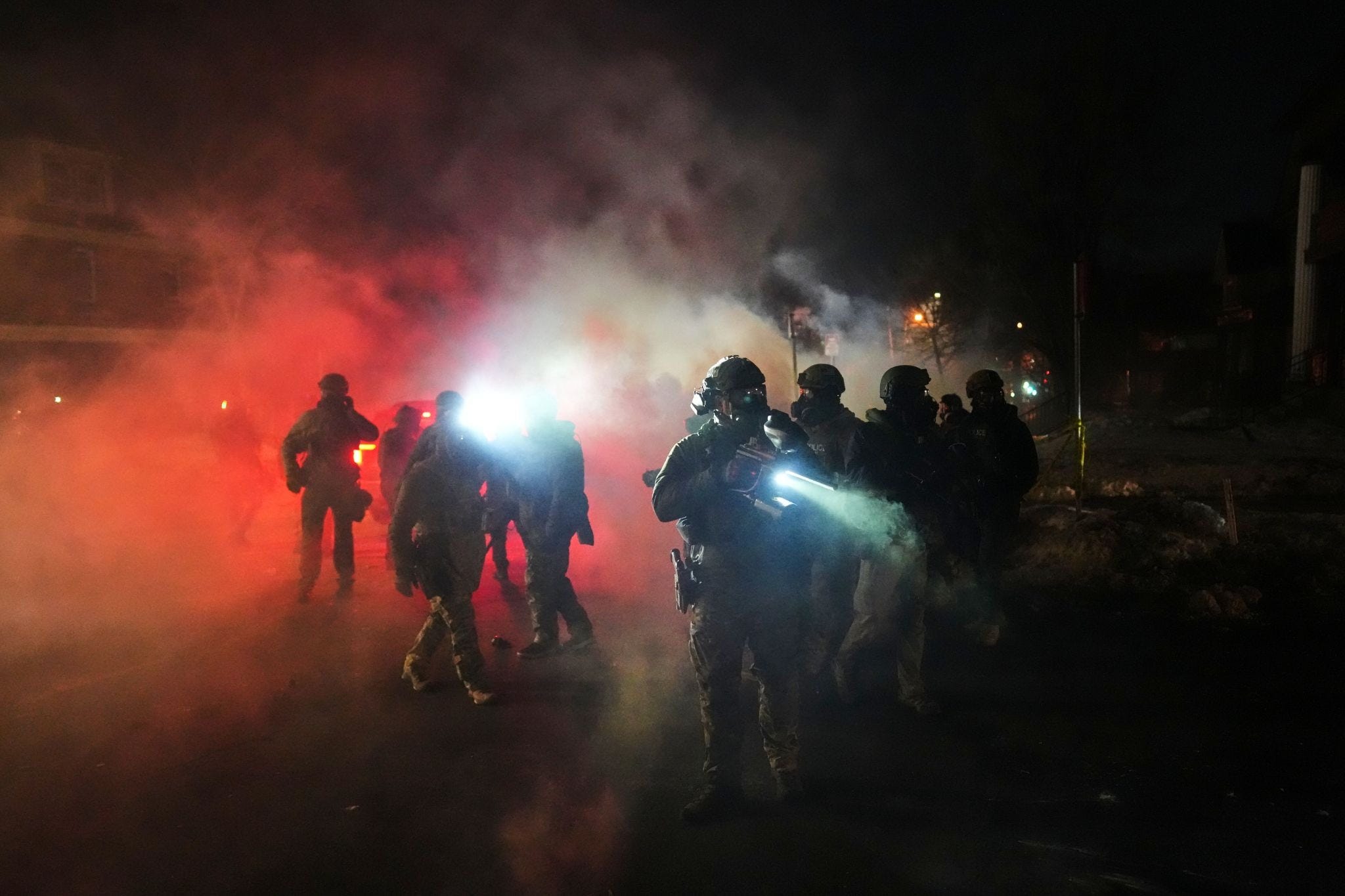
Now, many years later, I wake up to the news that there has been a second shooting in Minnesota by ICE agents in 2026. My social media feed is flooded with messages calling federal officials Nazis and criminals, calling for the abolishment of ICE, saying that anyone who supports the efforts of law enforcement to deport violent criminals from the country is on the wrong side of history. My head swims as I sip my coffee and log on YouTube to try to make sense of what has happened.
I feel nauseous and uneasy. At this early hour it isn’t clear what happened with Alex Pretti and the facts of the case, as we understand them at this moment, are difficult. Pretti had a weapon with two fully loaded magazines and he was interfering in an active law enforcement operation, but he also, it seems, was not threatening officers when he was shot.
To make matters worse, the Secretary of Homeland Security, Kristi ‘Where’s My Camera’ Noem, has chosen to play fast and loose with facts in a tone that is adding fuel to the fire. (For the record, Noem is the member of Trump’s cabinet I most disapprove of. Her dubious relationship with the truth and the story of her poor puppy Checkers alone are enough to disqualify her from public life in my view. )
But my intention here is not to get in the weeds about Pretti or Renee Good (whose case seems far less ambiguous to me), but rather to aim at something more challenging: what is the morally right and compassionate position? What do you do when any position you take will lead to human suffering?
In 2014 when Jose came to my office to ask for help and in 2022 when Dave and I were having a heated debate about illegal immigration and amnesty, I would have been certain that I knew what was right. I would have been on the side of the protestors in Minneapolis, I would have joined in with the chorus of leftist online calling Trump and his officers fascists, I would have been repeating empty slogans like “No Human is Illegal” without ever really thinking through all the implications of what that means. But this is not where I am today.
Over the last few years many of my political positions and affiliations have changed, which I have documented here on Substack, and the issue of illegal immigration and what to do about it has been one of the issues that brought about this change.
It’s not that I don’t have compassion for the world’s poor or for those who came to this country illegally in search of a better life, I most certainly do. I think about Jose and his father, along with all of the other people I have known well as students, coworkers, friends, and lovers when I contemplate this question. Yet, I hold to the belief that the most compassionate response to the question of illegal immigration in the United States today is to enforce the laws of our nation, to deport nearly all of the illegal migrants who are currently here, and only once this is done to begin a conversation about centrist compromises.
In the parts of this essay, I will look at all of the groups harmed by illegal immigration. I will use my research into the matter to buttress my opinions as best I can, and I will attempt to do so in a way that is informed by both the liberal and conservative parts of myself. I will discuss parts of the debate that my liberal friends never discuss on social media, and my hope is that by doing this compassionately I can attempt to clarify how a conservative can embody compassion while also asserting that the illegal immigrants to this country need to go. While it is generally unwise for a writer to state their intentions so bluntly, in this case it feels appropriate.
I know that I will inevitably lose more people I believed to be friends for posting this but so be it. The moment we stop staying what we believe to be true for fear of the reaction of the mob is the moment we lose our democracy collectively, and our souls individually.
I am not a white nationalist nor do I hate illegal aliens. I have great compassion for those who came to the United States in search of a better life, as my ancestors once did, but these are not the 1700s, America is not an unsettled frontier, and the issue of migration is vastly more complex today than it was then.
Age and wisdom have also taught me that sometimes doing the right thing means doing what is difficult, unpopular, and unlikely to be understood by others at the time.