
Mile Marker: Arches National Park, UT
Chasing the ghost of Edward Abbey in one of America's best National Parks

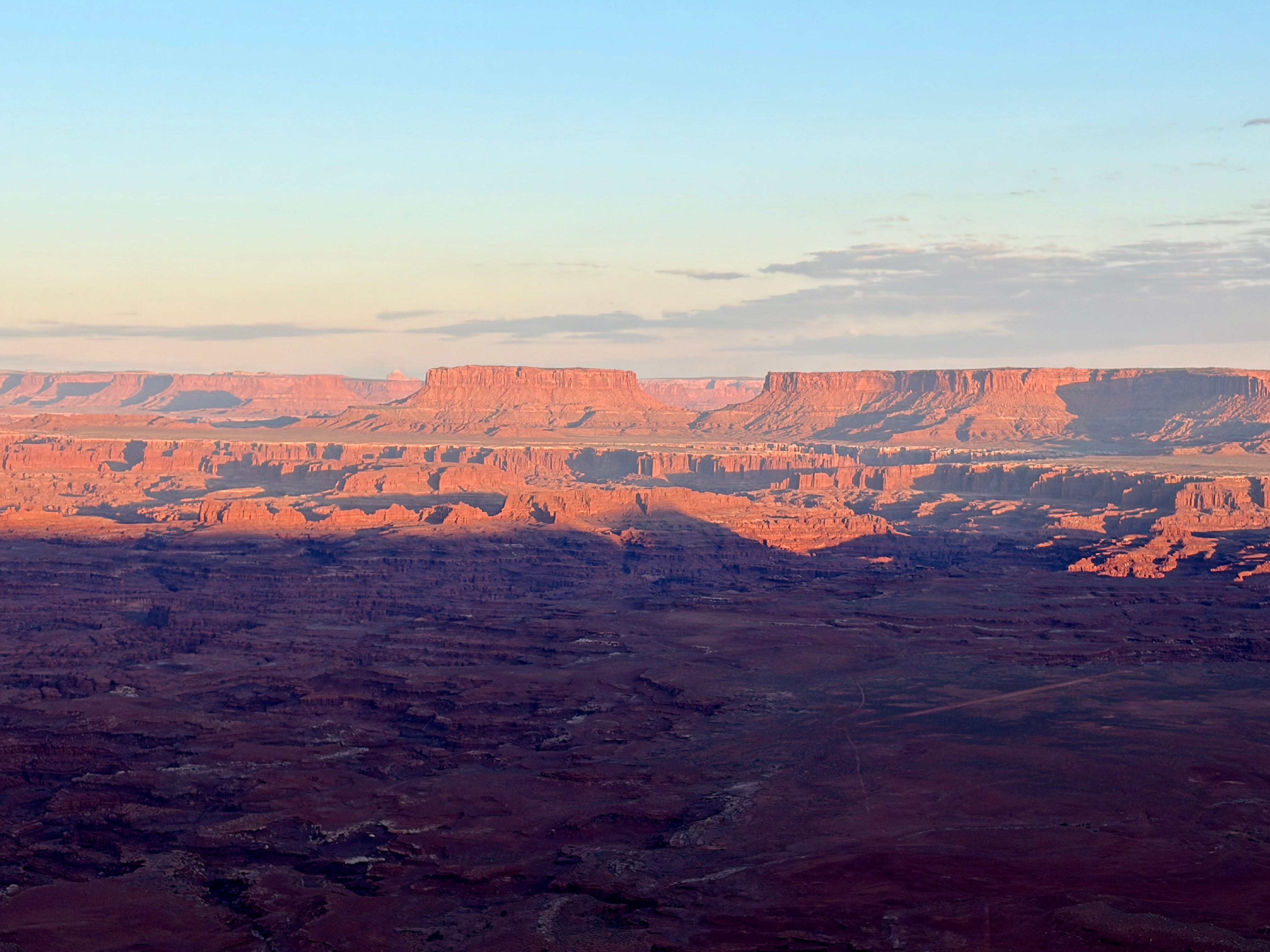
I wake up before dawn on Beltane optimistic for the day ahead. It’s chilly and the full moon is still visible as the sun begins to rise. I walk to the cliffside with my dogs to watch the daybreak. The canyons are covered in shadow but as the sun rises a veil lifts to reveal the wonder of the red rock. I make coffee and kindle a fire from last night’s coals. I tend to the dogs and by the time the sun is fully risen we are packed and ready to meander to Moab.
In my mind, Moab is much farther north than I’ve drifted on this trip but mental maps are made to be redrawn and after consulting a physical map I am grateful for my miscalculation. Arches National Park is less than an hour and a half north.
Previously on the Endless American Road:


I first passed through Moab almost a decade ago, but I wasn’t able to stay long as it was just a pit stop on the way from Santa Fe to southeastern Oregon. For the last 10 years Moab has remained one of those places I want to get back to but realistically wasn’t sure that I ever would. Despite its beauty, Moab was just never on the way to any place I was going, until today.
We stop in town to refuel and I’ve been around these types of towns enough to spot patterns—a generation ago Moab was a typical sleepy western town where rural parents could safely raise their children surrounded by God’s beauty. But today, the town has been “discovered”—first by outdoor enthusiasts, then tourists, and now the horrid hordes of Instagram influencers.
The town clearly swells seasonally and the locals bear that weathered look of people who spend half the year trying to keep their heads above water economically only to become the indentured servants of the vacationing masses during the busy season. It’s an irony that all across the West such places are becoming beacons for remote workers and the outdoor elites who move in, drive up the costs of real estate, vote to change the culture, then complain about the locals from whom they stole the town while claiming self-righteously that no one is illegal on stolen land (see also: Bend, Santa Fe, and every small town in Colorado).


Arches National Park sits on the northern edge of Moab and as I pull into the park I’m crestfallen by the line of cars waiting to get in. I recognize that National Parks are essential to preserving the best of our public lands, but I also loathe the tourism and the crowds. I resolve to make the most of this day even if solitude will have to wait until I’m back at my campsite this evening.
I feel some relief when I stop at the visitor’s center and it’s still a modest single building whose aesthetics speak to an earlier time. There’s a small gift shop but it’s nothing like the atrocity of Yosemite Valley.


At the visitor’s station I talk to a ranger, telling him my dogs are with me and I know this limits what I can see. Yet, together, we plot a route for the day. I’m about to walk away when I say: One more thing and I don’t expect you to know this because it’s kind of random but can you point me to any spots relevant to Ed Abbey’s time here?
The ranger’s demeanor brightens and then I’m not just another tourist but rather someone who knows something more about this place. Not only does he show me on the map where Abbey lived while he was a park ranger here in the 1950s, but he also tells me how to spot remnants of the septic tank his trailer was hooked up to. This is so random but I thank him mightily and head off to explore the park.
If you don’t know, Edward Abbey was a writer and godfather of the modern environmental movement (though whether he would go along with the agenda of the elites around climate today is a question for open debate). Abbey died in 1989 before global warming became the divisive issue of our time. Abbey’s focus was not climate but conservation—he cared about man’s soul in relation to wilderness and the natural world. I don’t think he would have been so easily persuaded by those who fly private planes to Davos.
Several years ago, in another life when I was a college professor with summers off to exercise, hike, and read books in my garden, I spent a summer break reading all seven of Abbey’s novels including two with scenes set in Arches. It’s not that I love all of them, though a few are very good, it’s that I loved his sensibility and his view of the land. He was a pragmatist who understood honest work with land but also expressed deep spiritual union with it. He wrote with reverence for nature and irreverence for the bullshit of our culture. To Abbey, the land in the Western United States was so valuable that sabotaging construction equipment and bombing dams (practices he called “monkey wrenching”) was not only noble, it was a game. He is also one of my heroes.
I follow the ranger’s instructions and turn away from the crowds, stopping to park where he instructed. I never do find the cover for the septic tank, but I take some time to sit and take in the view that Edward Abbey had every day that he worked here, seventy years ago in an Airstream trailer before the roads were paved, back when the National Park was still a National Monument, back when foreign visitors didn’t come from all over the world to visit here.
I know it’s not in the ethos of National Parks, but I also know what I have to do next. I go back to the truck and rummage through my camping gear until I find an enamelware bowl. I go back out to the desert, down an embankment where the tourists can’t see me, and I cut an ear off a prickly pear cactus with my pocket knife. I place it in the bowl then cover it with the red soil of Utah. Back in Phoenix, I will plant the cactus in a pot with its native soil and name it Hayduke after Abbey’s most famous fictional character.


The rest of the day is amicable and friendly. I make peace with the Instagramers though there are fewer of them here than at other parks I have visited. Mostly the park is full of foreign visitors, obnoxious groups of mountain bikers, and retirees.
I get in a range of conversations throughout the day—one woman and I walk a few minutes and have a spiraling conversation that shifts from climate change to grammar to AI to Finnegans Wake in a matter of minutes. Another time, I engage with a couple who bring up God often but seem to have the sort of off-road adventurer’s spirit that bonds so many of us when we encounter one another. I tell them the location of my secret campsite on the promise that they will not tell others.
These two conversations alone could not be more different, and I would be willing to wager that the three people I mentioned above have very different voting records. But out here, in the best of America, there is still a sense of camaraderie lacking online and in day-to-day life. There is still some residual sense that we are one nation and that these lands are the best of what our ancestors fought to secure for us and we must do the same for future generations in turn.


By the time the afternoon comes, I am ready to leave Arches to drive back to my little home on the cliff for another two nights. It is Beltane, and a ritual is about to begin, and today has been a bucket list adventure.
These days are rare and precious, and it’s always good to savor them as fully and slowly as possible, so I do.
🏜️ 🌵 🐾 🇺🇸 🔧 🐾 🌵 🏜️
Bonus: