Cougar! 🐾
When you stare into the wild, eventually the wild stares back.

Some people work so they can acquire fancy cars, designer clothes, or trips to Disneyworld; I work almost exclusively to afford leisure time in the wilderness. In an earlier age I like to believe I would have set out on my own to cross the continent, but in this age it’s just me, my trusty dog Jones, and a pickup that answers the call of adventure. That lust is not for a bucket list of destinations but rather for a feeling I’m chasing. As I prepare for a four-day adventure in late June and Phoenix crosses the 110-degree threshold, I know I need to be high in the mountains and far from crowds.
I settle on Greer, Arizona as my destination, an unincorporated community in the northeast part of the state I hadn’t visited yet. Jones and I pack up and leave on a Friday morning, with no need to be back until Monday evening.
I keep hoping to clear the traffic as Phoenix rescinds into my rearview, but there is more traffic than I would like. Still, I remain hopeful. Living in a city drains my soul, and I survive by finding these wild places where I can recharge and remember that life is more than the empty consumerism of the urban sprawl.
We pull into Greer mid-afternoon and the community is busy. The retiree/RV crowd seems to have found this place and that, coupled with recent forest fires that have closed many of the campgrounds on my list, lead me to do a U-turn at the end of town. Greer isn’t what I came all this way to find.
I survey my atlas and decide to head east to the town of Edgar on the Arizona/New Mexico border. From there, a vast wilderness area lies to the south. It’s getting late, so we need to move.
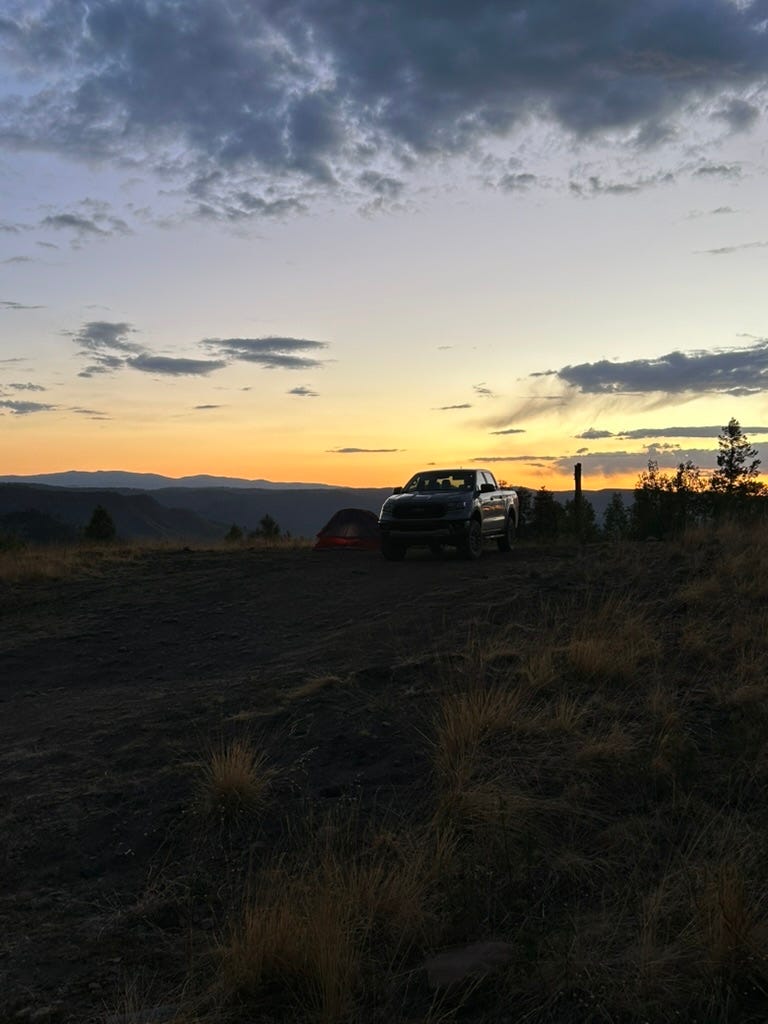
A few miles north of Alpine, a forest service road leads us along a creek for about a mile before forking up the side of a mountain. The campsites along the creek are taken, so we settle for an exposed, rocky campsite in a burned area for the night. The site is far from ideal, but the views are nice.
At sundown, Jones and I settle into our tent. When I wake an hour later my sleeping mat is completely deflated due to a tear I will discover the next morning, so I’m sleeping on the rocky ground. I toss and turn, upsetting the tired husky who is just trying to get some sleep.
Later that night, I’m jolted awake by a very loud sound near the tent. The sound seems metallic, like sonar or at least how sonar sounds in the movies. I imagine I hear footsteps nearby, a wild dog barks in the distance, and I am now fully alert. The mountain has come alive, and I feel vulnerable.
Despite sleeping alone in remote spots for years, that old feeling of fear and anxiety still creeps up sometimes. At night, alone in a tent, far from help in a wilderness area, you surrender to your own vulnerability.
Jones is visibly nervous, also on high alert, and I sit up with my arm around him as we listen to the sounds outside. I realize for the first, but not the last, time on this trip that I have left my pistol at home.
The sonar-like sounds continue, but as I shake off sleep and my rational mind takes over, I realize this is more likely some strange flock of desert birds than an alien abduction. All of this is amplified by the echoing in the canyons of the mountain where we are camped. I lie down, calm Jones, and try to get some sleep.
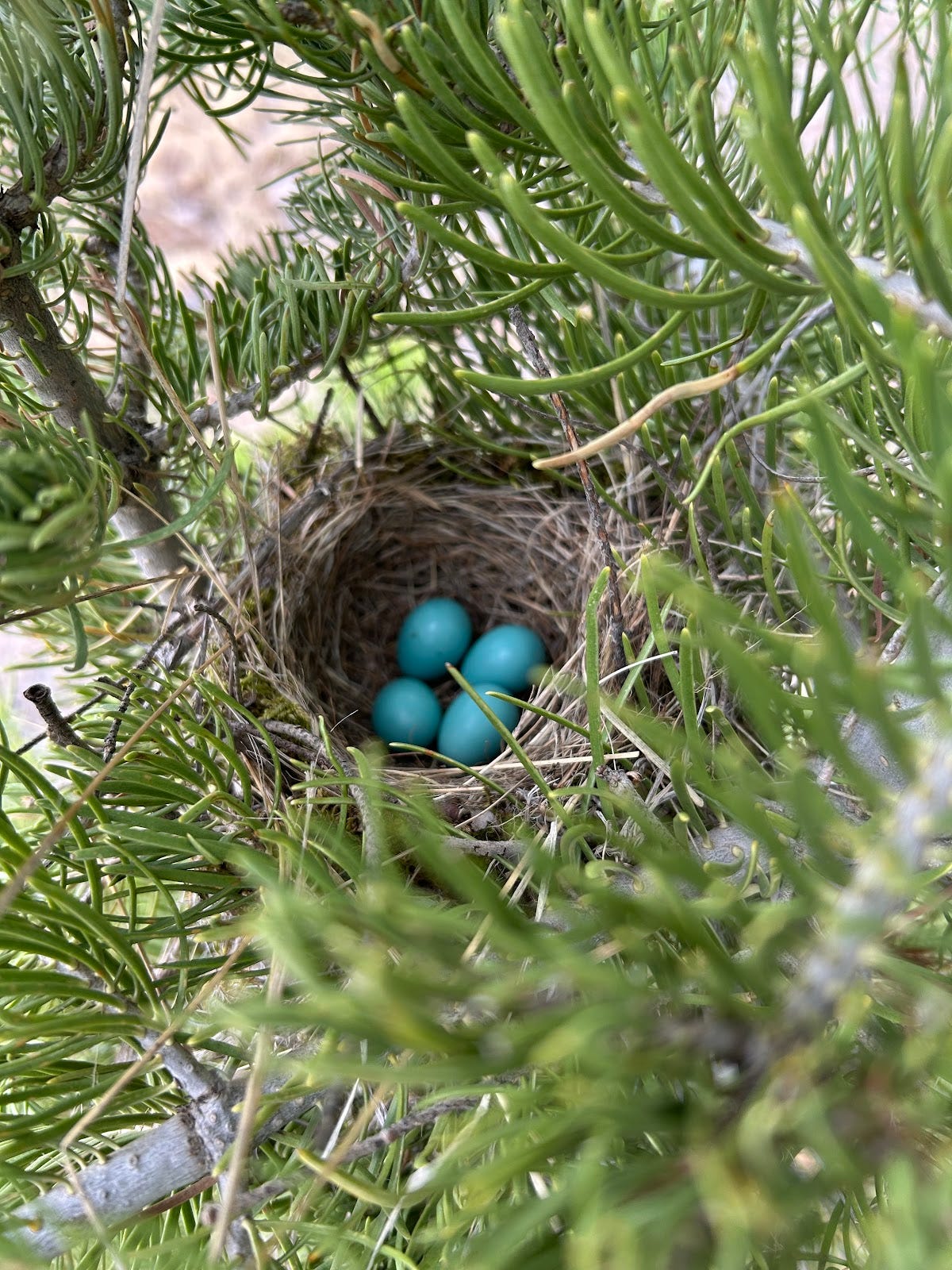
Strange birds aside, this portion of Eastern Arizona is full of wildlife. On our first day alone we saw elk, deer, turkey, rabbits, hawk, squirrel, and even three long horn sheep. I didn’t know then that our most shocking encounter was still ahead of us.
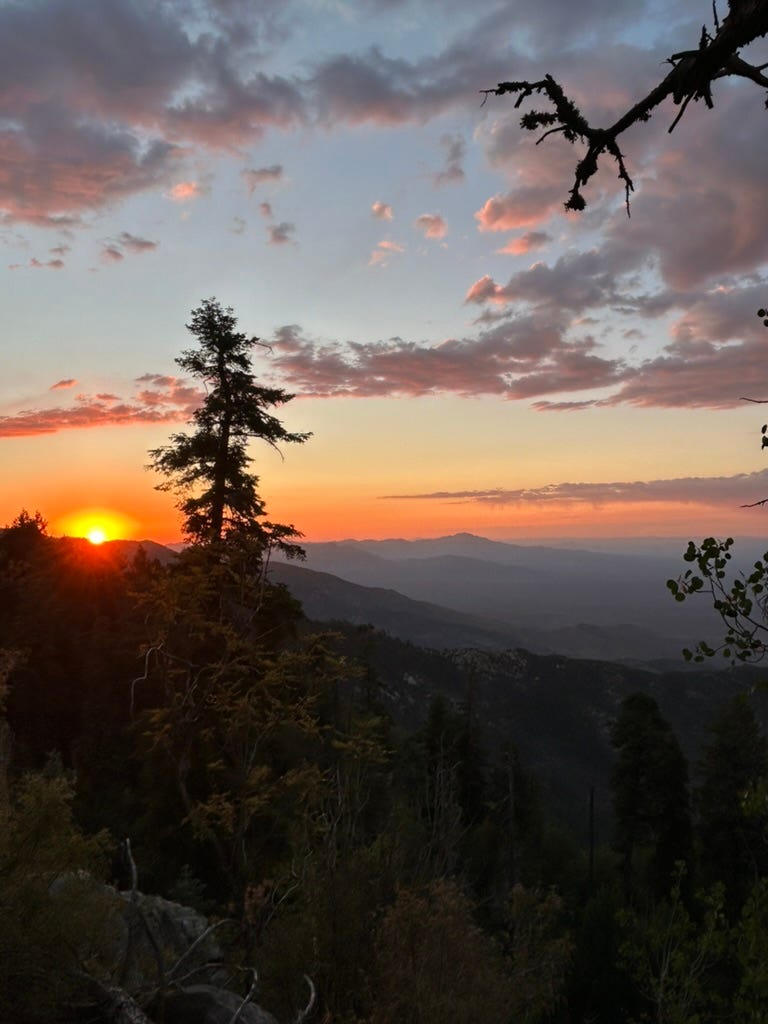
Still groggy from a terrible night’s sleep, Jones and I are up at dawn to watch the sun rise over the vast, remote mountains. As the sun intensifies, we break camp and resume our journey.
Near the ominously named Hangman’s Meadow (NOTE: It’s actually “Hannigan’s Meadow but I’m going to choose to remember it is as Hangman’s), an even smaller unincorporated community than Greer, we take a hike along a trail with “creek” in its name, though we never see water in that valley. As we hike, my mind wonders as it does and I find myself contemplating what it means to build a society on Christian ethics. It’s a random line of thinking sparked by some social issues I’ve been mulling over. Then I look up to see a carving in an aspen tree that reads, “Jesus Save my Soul.” Seeing a carving in a tree, evening a religious one, isn’t unusual, but seeing that particular carving on a trail this remote as you’re contemplating Christian ethics? That’s uncanny at least.
After our hike, we find a winding forest service road with a canyon drop-off on one side and wooded spots with occasional camp sites on the other. We drive for several miles, passing dispersed campsites but none of them feel quite right. Playfully, I visualize a ball of light and say: “perfect camping we will find.” I release the image as we round a corner where a secondary, less-developed forest service road splits off. We climb a short embankment, and at the top is a huge rock fire pit, a concrete slab supported by two tree stumps, in an open clearing with rock walls and trees all around. I have hit the dispersed camping jackpot.
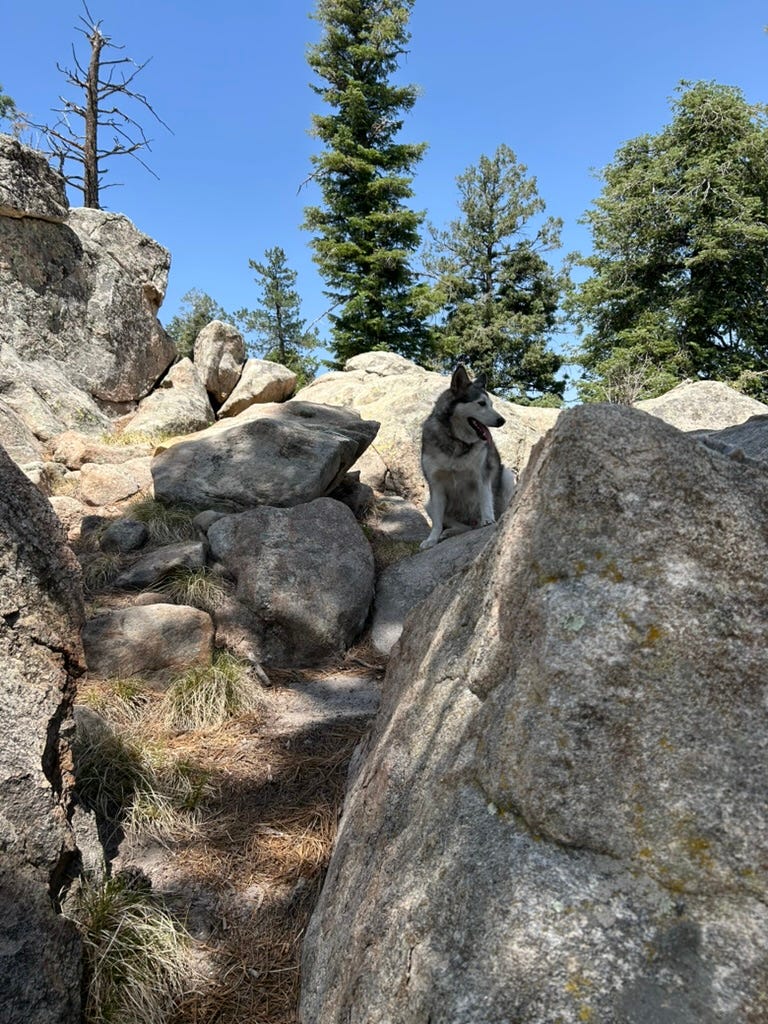
By mid-afternoon the sun beats down on us and heats up the day considerably. We move to the campsite’s edge and sit under a tree. The tree we sit under is distinct because reflective materials are nailed to the front of it in the form of a small cross. It’s not clear who has done this or why, but I remember the carving from earlier in the day and notice the synchronicity.
Some light rain moves in eventually, so the husky and I retreat to the pickup to wait for it to pass. When it does, I set out my chair and read a book as the husky sleeps at my feet. It’s around 5:30 in the afternoon, and I’ll need to set up for the night soon. I’m contemplating whether I should set up a hammock in the woods, sleep in the back of the truck, or put my tent on top of the makeshift table. My lack of sleep is catching up to me and I know it’s going to be an early night whatever I decide.
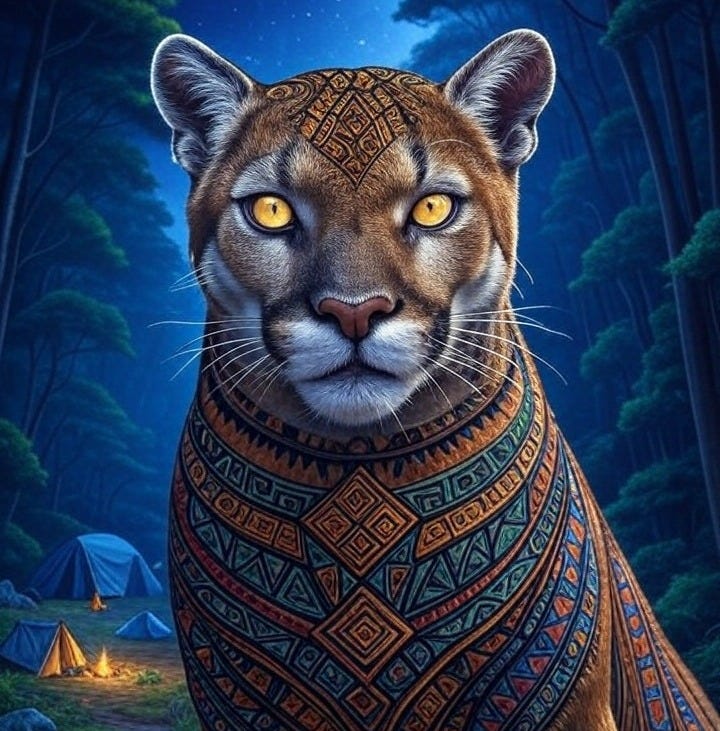
I hear a loud huff, like a heavy exhale, so I look up from my book and across the tree with the cross that we were sitting under just an hour before. I see a brown mass under the trees and think, “oh, deer,” but then I notice the animals shoulder blades come close together the way only cats do.
For a split second I am astonished by what I see, then I evaluate my defense options and realize I have none–not even a stick. For the second time on this trip, I’m reminded that I forgot my gun. My fight-or-flight responses kick in. The cat hasn’t noticed us yet, so I choose flight.
I’m out of my chair and around the back of the truck calling to Jones quietly as I move. When he doesn’t respond right away, I shout and he bops around the truck with total obliviousness. I grab him by the collar, throw him into the backseat, then jump into the front never taking my eye off the cat. It isn’t until I’m safe inside that I sigh deeply and let myself admire the cat on the edge of the campsite, maybe 100 feet away. The cat is terrifying in its beauty. I’ve seen cougars in zoos before and even behind glass they are intimidating creatures, but seeing one so close by in the wild is an entirely different experience.
The cat sniffs where Jones and I had been sitting. It looks our way, then slips back into the forest and disappears.
When I am certain it is gone, I jump out of the truck, throw our possessions in the back and take off. Under no circumstances are we sleeping at that site tonight, 10 miles off the highway, with no cellphone reception, as a cougar prowls the parameter.
Back on the highway, we head south and find an established campsite. There’s only one site on each side of the road, and a man in a van is already set up across from us. He waves when I pull in, and this time I’m not resentful of the presence of other people.
Fish and Wildlife estimates that somewhere between 1,800-4,000 mountain lions live in Arizona, yet the number of attacks on people over the past five years can be counted on one hand. Still, none of this matters when a cougar is standing within striking distance of you and all you could do, should it choose to attack, is put up the fight of your life.
I come to the wild to remember that I am an animal when stripped of all my protective gear and technology. I am still a replica of the early humans who settled the wild and fought for their survival back before the night was tamed. I venture to the wild to remember, to reconnect, and today that message came back clearly: civilization is just a veneer. When confronted with an apex predator, no amount of education or achievement will aid you in a fight for your life. What matters then is what mattered to our ancestors, cunning and brute force.
When you enter the wild it pays to say a prayer, to ask whatever gods or guardians you pray to for protection, to be aware of your surroundings, and—yeah—to bring a gun.