
Campfire Curriculum: Riders of the Purple Sage and Chronicle of a Death Foretold
The changing of seasons and a report on two more novels in our Beyond the Western Edge Curriculum


Utah, Ostara
I find myself on this final cool breezy weekend of Spring (Ostara) here in Arizona, thinking about Utah. This is fitting since I’m planning a trip there next today. On Beltane, I’ll be somewhere in southern Utah with the dogs, camping, exploring, and hopefully taking some time to read.
It’s fitting also that I finally got around to finishing Zane Grey’s Riders of the Purple Sage today, the third entry in my “Beyond the Western Edge” Curriculum.
When I pulled my tarot cards for the year (more on that in a future post), I pulled the Five of Wands for Ostara, this Spring season now at its end. This card in the Thoth tarot deck means something like clashing wills, or the pulling of action into too many directions. It’s a card of conflict but not unwinnable conflict; conflict that is part of the struggle to actualization.
And so this season has been. It’s been a struggle, though hard to put my finger on why that struggle has persisted. Instead of Spring cleaning, my home devolved. The dishes piled up, notes went unanswered, I slid then plummeted off of my diet plan, I did cut back on alcohol and intoxicants but this led to relapses and excess, and in my reading and writing life—I found little joy. Even writing this feels heavy, laborious.
That has been my Spring and my lack of productivity in posting here shows it. In a culture where we make believe that we’re supposed to be productive all of the time, what does it mean to say—I failed. I couldn’t do it. I feel like I’ve wasted my time. Everything felt like a chore.
I picked the books for this curriculum from books I hadn’t read yet with the assistance of AI, so what does it mean to come to you now and say—yeah, I didn’t really like these two books. I’m making revisions to the curri, so here I am today, with my report and my revisions.
Below, I’m going to look at the two books for the curriculum that I read this season. Then I’m going to make some revisions to the curriculum before stepping away to begin packing.
Riders of the Purple Sage by Zane Grey
I had heard the name Zane Grey before but I didn’t know anything about him when I came upon a leather-bound copy of five of his novels for $2. It wasn’t until I put the book on this curriculum that I did some background research and learned what a giant Grey is in western literature.
During his life, Grey sold 20 million books, with that many more sold posthumously. Even in the 20th century, when reading was still a widespread common pastime, Grey reached a level of popularity few writers can dream of. His reach within the western genre is second only to Louis L’Amour—and L’Amour can be found in nearly every middle-school literature textbook (I once had a job at a publishing house putting these books together, so I can attest to this!). So why have I, with two advanced English degrees focused largely on 20th-century American lit, never read Zane Grey? Is this one of the forgotten masters I’ve been looking for?
While Grey’s prose is rich and his imagining of the western landscape a nice complement to the books in this series, I have to be honest that I really disliked this book. Though it was published in 1912, it feels older and deeply out of sync with modern sensibilities.
That Riders of the Purple Sage had a huge influence on the Western film genre is certain; you can find here all of the tropes and ideas that would play out in the western films of the early 20th century.
Grey was writing about the myth of the frontier, which had officially closed a few decades before the book was written. The novel takes place in Utah, and Grey’s impression of the Mormon settlers who live there is dated and, well, complicated.
A heroine of the novel is a Mormon woman dedicated to her faith—rich, successful, but under pressure to engage in polygamy. She is an outcast on the western frontier, and in this respect the novel seems ahead of its time.
Simultaneously, though, the book is full of stereotypes and an old prejudice toward Mormons that I’ve encountered many times from people who grew up in the West. Frankly, it’s an odd heritage that no one talks about. Yet it’s worth noting that the Bundys as well as Senator Mike Lee from Utah are all Mormons and have all been in open rebellion against the federal government and its allocation of western lands to the public. So, as odd as these prejudices seem to the modern reader, there may also be some historical reality to them that is still playing out. It’s a nest of stereotypes, prejudice, and conspiracy that I just, frankly, don’t care enough to untangle. The Mormons I’ve known in my time out West seem nothing like the dubious ones in this novel.
The best part of this novel is the landscape and the mystical tone Grey takes when he writes about it. The purple sage of the western plains, which is mesmerizing when first encountered, feels like a bardo space—a last remaining piece of frontier that is still wild, where a rider can escape the encroaching civilization. The characters in the novel retreat into the sage throughout the story.
The value of this novel is that it wrestles with one of the many groups who found a home on the western frontier. The Mormons as presented here are largely unlikeable people, particularly the elders of the church, but in fairness are they really so different from the protagonists of Lonesome Dove? In both novels, groups (men) took what they wanted, claimed land from the frontier, and asserted ownership with brute force and coercion. I would certainly be cautious in recommending this book to a modern reader, but as a snapshot that captures the making of the American western frontier, it is interesting.
Chronicle of a Death Foretold by Gabriel Garcia Marquez
Let me begin this section by saying that Gabriel Garcia Marquez wrote two of my favorite novels—A Hundred Years of Solitude and Love in the Time of Cholera. I would put both of these novels on any list of the world’s finest novels. But the remainder of his vast canon—10 novels, 4 short story collections, and 8 works of nonfiction—is a mixed bag. That he is a master capable of elegant passages even in stories I don’t connect to is undeniable, but I often find myself longing for the connection to character that is present in his two masterworks.
And that is the problem with Chronicle: it is interesting, yes—mythical and strange in its exploration of a South America that, like the western landscape of America, lives in myth and memory as much as reality. But try as I might, I just don’t care about the characters in this book.
I was about 20 pages into the slim novel when I realized that I had, in fact, read it at least twice before. And yet, I couldn’t remember it. Santiago Nasar, the young man whose death is traced in the book, is a womanizer, a young playboy, and it is his reputation more than his actions that leads to his demise. But he floats through the book like a ghost. Maybe this is because we know he’s going to die from the beginning, but I would say he also lacks the depth required to carry the story.
Chronicle is perhaps best understood as a bold experiment. Where most books hold their central action until at least the third act, this one gives it away right up front. The novel is less about plot than it is about investigation—this is the story, but how did it happen? The plot is reconstructed through interviews and recollection, and like all of Marquez’s work the thin line between “truth” and rumor, story, and memory is a hazy one. Ultimately, the novel doesn’t do much to advance the central questions this curriculum seeks to explore, and it’s not one of Marquez’s works I would recommend to a new reader.
Revisions
And so it is with making a curriculum, you pan for gold. Sometimes you find gold but more often you just find shiny pretty objects that just aren’t what you’re looking for. So, thinking about the curriculum as a whole, I’m making some revisions. Below are the original 17 novels I’d selected but with these revisions: where there are multiple books by a single author I’m choosing one, I’m cutting those books that don’t seem to fit the central theme, and I’m picking a different book by one author. Here are the changes:
Lonesome Dove by Larry McMurtry
Chronicle of a Death Foretoldby Gabriel García MárquezRiders of the Purple Sageby Zane GreyBlood Meridian by Cormac McCarthy
Wolfby Jim HarrisonLight in August by William Faulkner
Love in the Time of Choleraby Gabriel García MárquezDalva by Jim Harrison
American Pastoral by Philip Roth
Joe by Larry Brown
Streets of Laredoby Larry McMurtrySo Much for Thatby Lionel ShriverRevision: A Better Life by Lionel Shriver
Bad Country by C.B. McKenzie
Deep South by Paul Theroux
Wildby Amy JeffsStalking the Wild Pendulumby Itzhak BentovAgainst the Machine by Paul Kingsnorth
From seventeen, ten novels are left standing. Let’s see where the curriculum takes us by the end.
The End of the Season
At the end of Ostara, I’m feeling like the season got away from me but as I sit here tonight with a clean house and a five day camping trip to Southern Utah taking shape, I take a minute to reflect on all that did happen this season.
I saw two great concerts—Pusicfer and Interpol—both of which were remarkably good, I spent time with friends, made some new connections, had my first real victories at my current job, planted two raised beds, bought tickets for a trip home to Kentucky in June, explored the southern Arizona border, and spent some time in the vast desert near the Arizona/California/Mexico border. I didn’t do everything I set out to do, life often felt like a burden, but looking back—I did better than it seemed when I sat down to write this.
Now it’s Beltane and the red rocks of Utah are calling, and I’ll let you know how things are out there on the Road. Maybe I’ll see you out there. Maybe we’ll pass in the night. Maybe we’ll take some time for black coffee and cherry pie together.
Whatever happens, there is a frontier waiting to be explored, and nine more novels to be read before this project concludes.
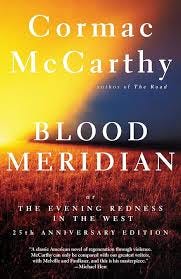
Join me for our next novel: Blood Meridian by Cormac McCarthy. This one has been on my list for years. Pick up your own copy at this link.
See you out there! 🚙 🐶🐺🌄 🇺🇸