
Campfire Curriculum: Blood Meridian by Cormac McCarthy
The Desert Does Not Forgive

I finished Cormac McCarthy’s Blood Meridian, or the Evening Redness in the West under the duress of a fever brought on by a virus over the July 4th weekend. As the sky lit up in fireworks celebrating the 250th anniversary of the country’s founding, I was indoors pushing through a fever dream—the tale of a bloody chapter that took place on the same lands I call home today.
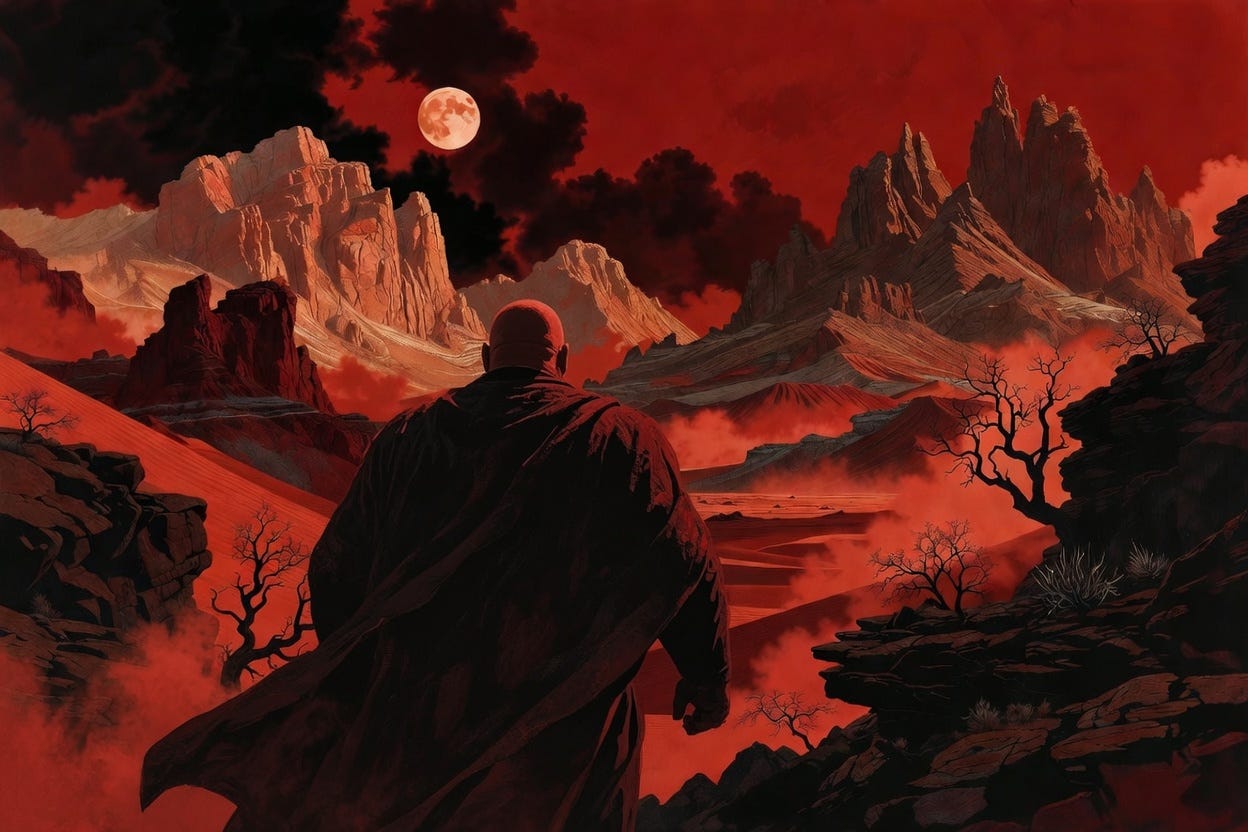
Blood Meridian is the kind of novel that seems to have crawled out of some Lovecraftian fissure in the earth.
If Lonesome Dove represents the western in all of its romantic, archetypal glory, then Blood Meridian is the antithesis: a western novel stripped of all romance. It is a war novel without a war, an allegory rooted in history.
The novel does not have much of a plot, nor does it really have many well-defined characters. The story goes something like: a boy known as the Kid drifts west from Tennessee and joins a renegade band of soldiers who set out from Texas to rid the lands of northern Mexico of the Apache and to stake early claims on this land that they believe the young Union will annex. The company moves through the borderlands engaged in brutal conflicts with the Apache. Most of the company dies, but those who survive eventually join a band of scalp hunters led by The Judge. Under the Judge’s tutelage the band enact their revenge and are briefly celebrated as heroes until they, too, begin a rampage of indiscriminate massacres.
The Judge is a bald, imposing man—a figure of deep learning and incalculable cruelty. He is the book’s central force, less a conventional villain than a demiurge, a counterfeit creator who claims dominion over all he encounters. He understands that force precedes the moral language men later invent to justify it. Violence itself is holy.
The first time we meet him, the Judge appears in a revival tent at the edge of a settlement where he accuses a traveling preacher of depravities involving children and animals. As chaos erupts, he slips out of the tent to watch the violence unfold. He knows that the piety of a revival is just a mask for man’s true nature. Exposing this is just a game to the Judge, an act done for his amusement.
Part of the effect that Blood Meridian has on the reader comes from knowing that as fantastical as the novel becomes, a true history runs beneath it.
McCarthy based the book on historical events when, after the Mexican-American War, Mexican states offered bounties for Apache scalps. The Apache were a ruthless, violent tribe—they had few friends among any of the settlers or other tribes. The reality of their carnage is often glossed over today when revisionists speak of gentle Native Americans, as though there were only one type of clan that lived here before Europeans.
John Glanton operated a real gang of scalpers that did turn to indiscriminate killing and banditry; Glanton himself was killed in 1850 during an ambush at a Colorado River crossing. A Judge Holden, marked by his baldness, appears in Samuel Chamberlain’s mid-nineteenth-century memoir My Confession. He is certainly an inspiration for McCarthy’s Judge, for McCarthy was an avid scholar of the American West. While Blood Meridian is a work of McCarthy’s complex and dark imagination, the scaffolding of the story is real.
In the southwest desert today, I work in a brutalist office tower and spend my lunch breaks at a nearby cafe reading. One day I finished a particularly bloody chapter of Blood Meridian just as my thirty-minute break came to an end. I put down the book and rubbed my eyes, shaking images of mutilation, death, and torture from my head before walking across the courtyard to my office and up the elevator to my cubicle, where I sat for the remainder of my mandated workday and tried to pretend that civilization is real.
Sometimes when I am camping in the desert I get up in the early morning just before dawn and take a walk among the ocotillos, listening to coyotes before the sun paints the hills red. The desert feels more feral at that hour. Though I live in the desert and I respect it, there is a part of me that will never really love it. I am under no delusion that man is supposed to live here.
Reading McCarthy reminds me that the cost of domesticating wilderness is always blood. Those who settled in the desert had the hardest lives of all the settlers. They lived with the type of justice that knew if you murdered a man in the desert it was unlikely anyone would find his remains except for the buzzards and coyotes.
We build sports arenas, casinos, and swimming pools in the desert now. We build looping suburbs that seem to go on forever. We extend vast highways into every open plain. It is all foolish, and we know it. Phoenix, Tucson, San Diego, Los Angeles, Las Vegas, Tijuana, Albuquerque—none of these cities should exist. In time a reckoning will come. The land will return to the desert, red and brutal and lawless.
Blood Meridian is a masterpiece; it reminds us of our place.
Campfire Curriculum Updates
If you’re following along with Campfire Curriculum: Beyond the Western Edge you’ll know that it is an iterative process. My focus now is to narrow my initial list of books to seven novels along our theme. Right now I have:
Lonesome Dove by Larry McMurtry
Riders of the Purple Sage by Zane Grey
Blood Meridian by Cormac McCarthy.
Next up, I’ll be reading:
Dalva by Jim Harrison
And after that:
American Pastoral by Philip Roth
The Monkeywrench Gang by Edward Abbey
A Better Life by Lionel Shriver
Have you read Blood Meridian? I’d love to know your impressions in the comments below.