
Campfire Curriculum, An Introduction
Beyond The Western Edge: A Course on Virtue, Sin, and Frontier Sagas

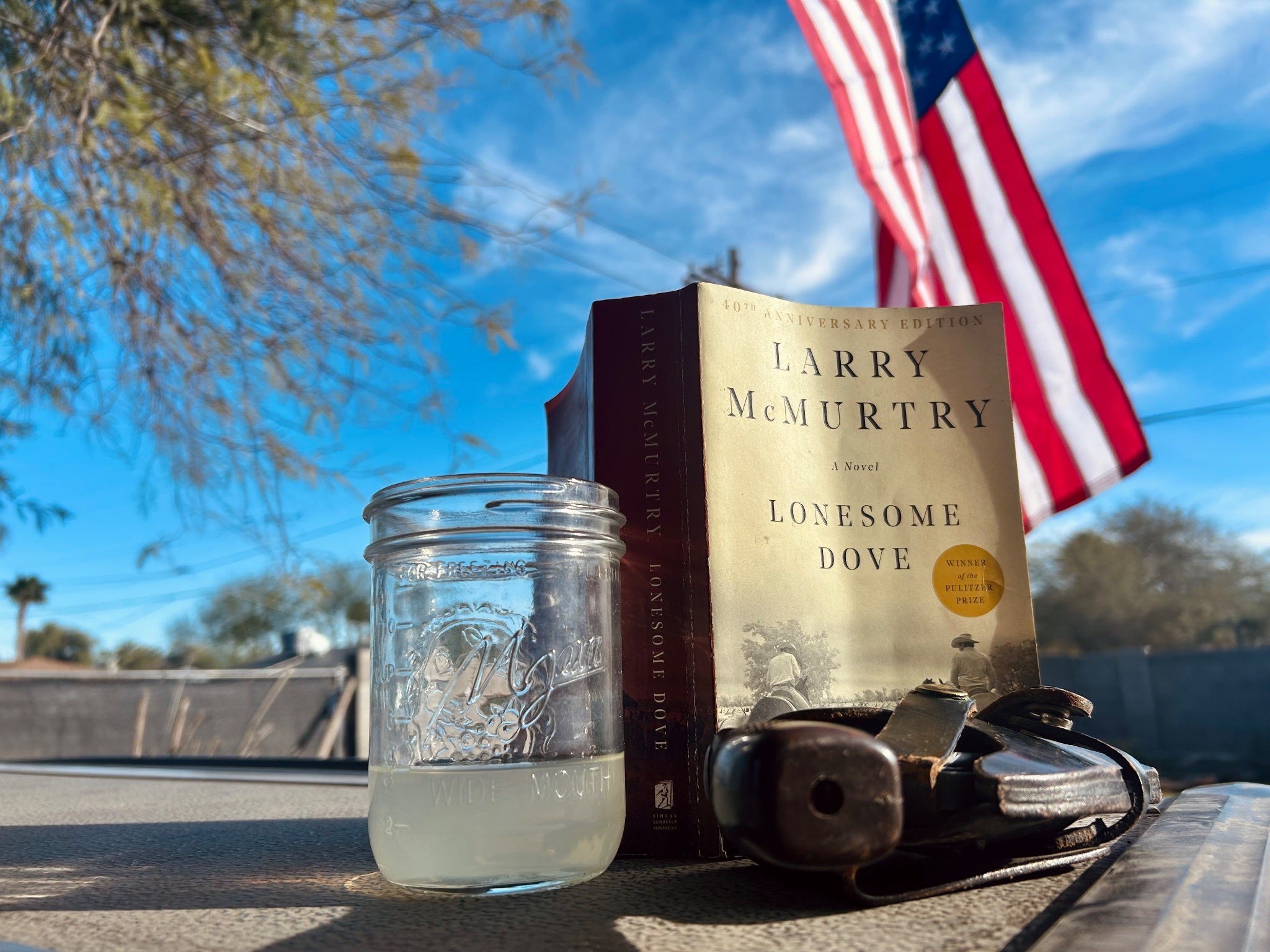
Required texts: Pick up your copies here.
Even in Arizona, the winter can be dreary though it’s hard to complain about cool weather in a state where half of the year is in the triple digits. Still, I am feeling the profound restlessness of winter–too many weekends in town, too much traffic, too many people, too long spent staring at home projects I know I ought to get started on but don’t.
In this season, I long for some time in nature but it’s more than that—it’s a longing for the person I am when I’m on the road. When I’m camping on the edges of spring, a typical day at camp goes something like this: I wake in the predawn hours and watch the last of the stars fade. It’s hard to get out of bed, even when your bed is a camping mat in the bed of a pickup. But eventually I hear the dogs start to stir, so I get up and let them out. They are drowsy at first but quickly find their vigor and start to play. Their energy in the morning is enviable.
I make coffee and am grateful for the steam rising from my cup as the first rays of sun breach the horizon. I wander aimlessly through the desert letting the dogs play. If I’m lucky we’ll scare up a jack rabbit or two, and hopefully nothing more menacing since the desert is full of both plants and animals that want to hurt you. As morning breaks, we head back to camp, I feed the dogs, eat some snacks, and pick up a book.
I read until the morning warms enough to shed some layers. I pick a destination from my list and load up the truck to go on an adventure. The playlist picks up where it left off when we parked the night before, and I ride with the windows down and the music blaring feeling happy to kick up dust. I feel free out here—connected to a lineage of explorers from the old world to now. Travel is much easier now, but no less awe-inspiring and no less essential.
We find a trail and hike so that by the time midday comes and the temperature starts to rise, we are ready head back to camp where there will be much roaming and reading, the dogs play until they don’t want to play anymore. Sometimes there’s a second adventure, sometimes I drive to the closest town to chat with the locals and explore, but on my happiest days we just stay at camp–watching the landscape wear the drag of the passing day.
As the sun starts to set I remake camp and fix a modest dinner after building a small fire. Once upon a time I sat up late into the night by the fire drinking, but these days I’m in bed not long after the first stars come out. The dogs settle back in the truck freeing me to wake throughout the night to watch both the Milky Way and Moon travel across the sky. The next day, I wake just before dawn and think about the adventure that the day holds.
Lately I’ve been reading literary works by male authors very deliberately. Particularly, I’ve been trying to reclaim a certain kind of literature that has fallen out of fashion. Not so long ago the writers I’m reading sold enough books to make an honest living at writing, something few male writers today (who don’t play into the identity politics and political agendas of the cultural elites) can do.
I am at the age where a man starts to realize that if you’re not who you want to be yet, then it’s time to get to work on the pieces you can control.
One of the areas where I have gotten lazy in recent year is in my reading. Despite being a slow reader, I still read more than nearly all the men I know but for a while now it has felt aimless. I choose books haphazardly and sometimes find myself reading low caliber books when there are still so many classics and great American writers sitting on my shelf waiting to be discovered. So this year I’m choosing a more deliberate approach.
One of the things I miss most about teaching is writing a great syllabus. A syllabus, when done well, should tell a story–something like: “these are the questions I’m pondering and here are some materials I’ve found that have made me wonder about those questions in a variety of ways. I’m inviting you to take part in the conversation with me.”
I decided that this year I would build a curriculum for myself. My goal–it’ll be deep, it’ll be thematic, it’ll focus on a lot of those “forgotten” writers I’m trying to reclaim, and most important of all–it’ll be fun.
But how do you build a curriculum for yourself from books you haven’t read? One thing students failed to appreciate was that anything I assigned them, I had already read. I read again as they read it, and if it remained on the syllabus I read it anew term after term. But in designing a curriculum for myself, I don’t have that luxury.
To get around this, I decided to use a custom built version of Grok. I sat down last week and took a stack of books I keep “meaning to read”, sorted them into a sort of order, and put them into the program. I told the AI how many hours a week I had to read and that these were the books I was interested in reading. I fed a bunch of other information in as well–personality assessments, horoscopes, all of my writing here, my larger ambitions for the year–and through much back-and-forth Grok and I culled that pile of books (around 50) down to 17, grouped around a common theme.
The end result is a self-directed curriculum for the year called “Beyond The Western Edge: Virtue, Sin, and the Closing Frontier.”1 It’s a syllabus for a class I would like to have taught had I ever been granted the freedom to do so. It is rugged, mostly American, unapologetically male, uninterested in identity politics or “inclusion,” contemporary in the sense that all of the books are from the 20th and 21st centuries but completely uninterested in postmodernism or any of the “-isms” that have driven conservative and blue collar men away from reading in droves2.3
Not forgetting the fun part, I also fed my record collection into AI and asked it to select a few records to soundtrack each book. Rounding out the curriculum, I also asked the AI to select a simple cocktail recipe inspired by each book. The results are impressive.
The final curriculum is below, and I hope to share the experience of reading each of these works—and maybe some reflections on the tunes and tonics that go with them—here on the Endless American Road.
The goal of this project, if I have one, is to discipline myself but also to encourage others–particularly men who have largely dropped out of the fiction market–to reengage. Log off, take some time to yourself, wrestle with a great book, learn to mix a stellar cocktail, listen to jazz while reciting moving passages for your dogs who are curious about—but unimpressed by—your recitations, go to bed a bit tipsy but wondering why the characters you’re reading made the choices they made. Let them, and the language used to render them, haunt you. It’s better than anything happening on Instagram.
I start this series with Larry McMurtry’s western epic Lonesome Dove. It’s a doozy of a read, I’m through about 300 of the novel’s 850 pages, and with any luck I’ll soon finish it by a campfire while listening to coyotes in the distance. It’s the start of a good year in reading that I plan to share with you, and a small step toward claiming some fundamental aspect of the life I want.
This syllabus explores America’s—and humanity’s—enduring preoccupation with frontiers, rooted in the nation’s founding virtues of self-reliance, moral courage, and ordered liberty. It traces the frontier spirit from outward conquest to inward reckoning, reminding us that true progress respects permanent things: the moral order, human limits, and the wisdom of tradition.


